
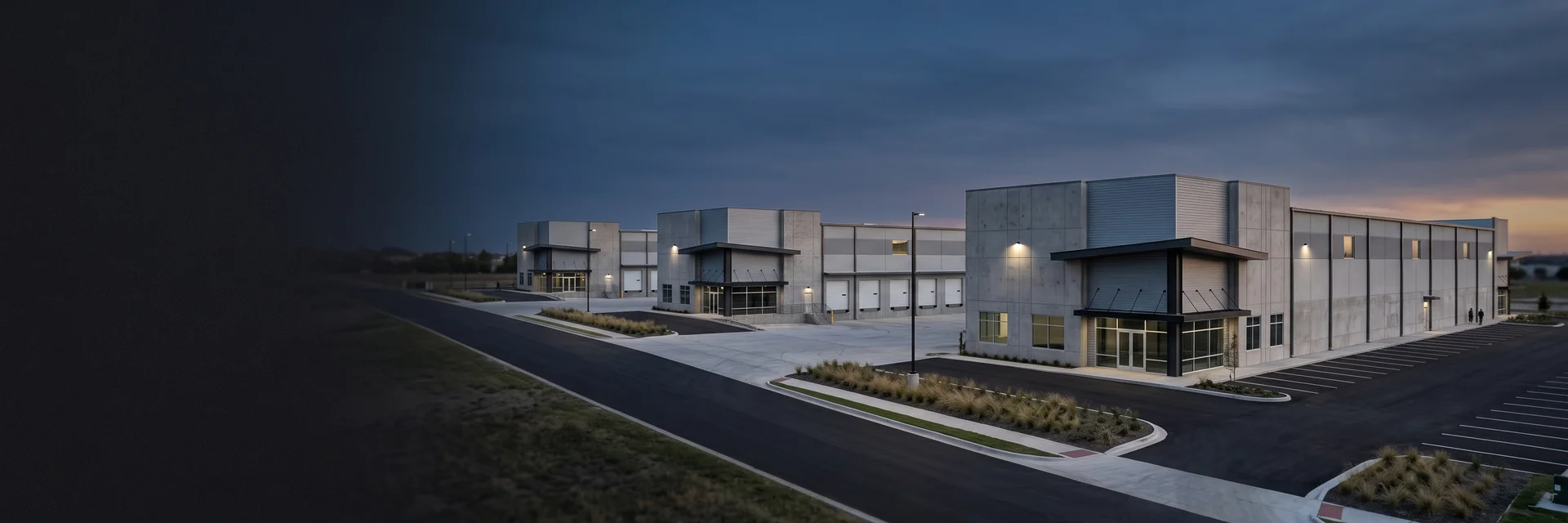
Repeat locations, one system
Multi-site programs delivered as one system
For banks, retailers, service brands, and fleet operators with repeat locations. One preconstruction and delivery system, applied so every site benefits from the last.
- Prototype and standards reviewed once, applied at every location
- Pooled long-lead procurement and consistent trade partners across a region
- Occupied branches and stores phased so they stay open
Repeat locations reward a repeatable system
A rollout looks like the same building over and over. It is not. Every site has its own jurisdiction, soils, utilities, neighbors, and opening date, and every one of those can push a location off the program schedule. Owners who run programs are not buying a building. They are buying predictability across a map.
AP applies its standard preconstruction and delivery system across locations: the same estimating and bid leveling in BuildingConnected, the same prequalified trade base, the same Project Manager, Superintendent, and Project Coordinator structure, and the same three-week look-aheads. What changes for a program is what gets shared between sites and reported up to the owner’s program team.
This page explains how AP sets that up, from the prototype review to the last opening.
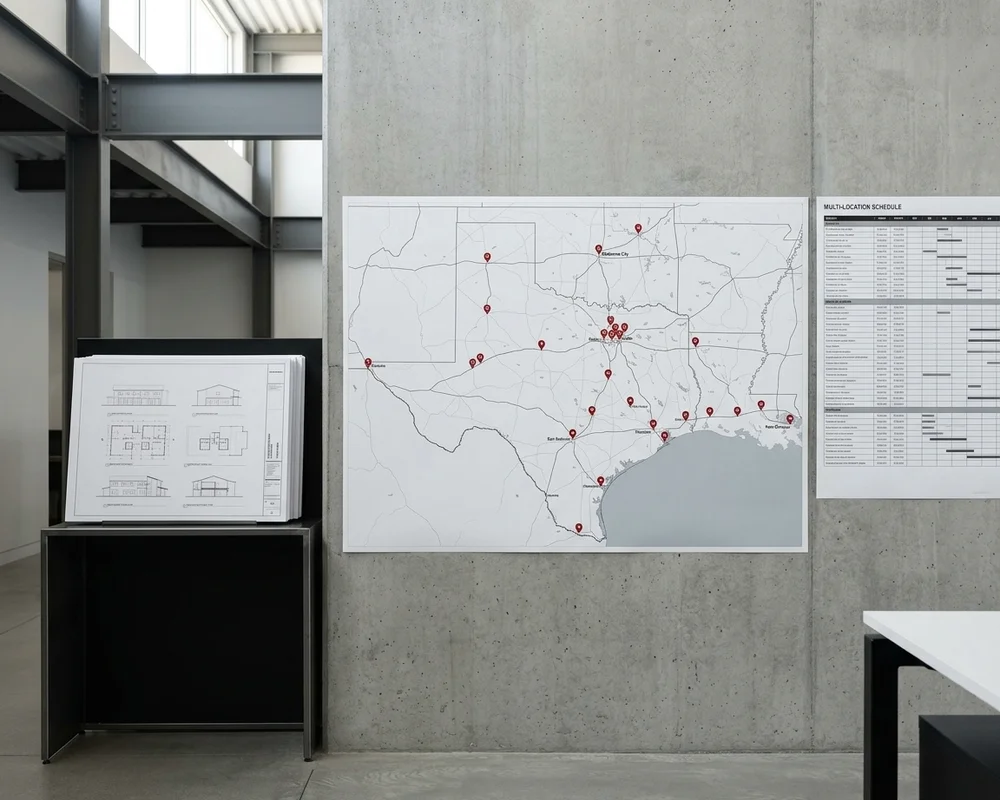
What a program owner gets from AP
A prototype that gets cheaper to price
Every location refines the estimate for the next one, so the program budget tightens with every location.
Variances you can see
Where a site departs from the prototype, the cause, the cost, and the schedule effect are logged and reported.
Openings in sequence
Locations are scheduled as one program with staggered starts, shared procurement, and opening dates the brand can plan around.
One reporting line
The owner’s program team hears from one AP team, in one agreed format, across every location.
Markets
Where programs run
Bank Branch Construction
New branches, relocations, renovations, and multi-site rollouts for banks and credit unions, built around security, occupied operations, brand standards, and opening dates.
Retail Construction
First-generation shopping-center build-outs, freestanding retail, and brand rollouts delivered to a fixed opening date, proven on a 16-week build-out in the Dallas-Fort Worth area.
Automotive Service Centers
Service centers, dealership service departments, and vehicle maintenance facilities with lifts, fluid systems, wash bays, and customer space, drawing on AP’s Penske fleet-facility work.
Truck & Fleet Facilities
Truck service centers, fleet maintenance shops, fuel islands, truck washes, and heavy-duty yards, proven on two Penske facilities in Texas.
Prototype and standards review
A program starts with the prototype: the drawings, specifications, brand standards, and equipment lists that define what every location should be. AP reviews that package once, for constructability, cost, long-lead content, and the details most likely to vary by site. The findings become a baseline estimate and a list of decisions the owner can settle for the whole program rather than location by location.
Site-by-site preconstruction
Each location then gets its own preconstruction pass against that baseline. Site conditions, survey, geotechnical information, utilities, access, and parking are checked, and the prototype estimate is adjusted for what the site actually needs. The result is a location budget the owner can compare directly to the program baseline, with every difference explained.
Jurisdiction variances
The prototype meets one code interpretation. Each city and county has its own. AP maps the permitting path for every location with the jurisdiction and the licensed design partners who prepare the submittals, identifies where local requirements change the prototype, and sequences approvals so a slow review in one city does not stall the program.
Procurement leverage and long-lead pooling
Repeat locations let AP buy differently. Long-lead items that every site needs, such as electrical gear, storefront, roofing, HVAC, security and vault components, or specialty equipment, can be released in pooled orders with staggered deliveries. Trade partners price the program, not one job. AP tracks the pooled procurement log against each location’s schedule so equipment arrives when the site is ready for it.
Governance and reporting
Before the first location mobilizes, AP and the owner’s program team agree how the program will be governed: who approves variances, how program-level decisions are recorded, and what the owner sees. AP sets up the reporting to match, covering location status, cost against the program budget, schedule against the opening sequence, open variances, and procurement position, in the format and rhythm the owner’s team works in. Procore is the shared record across every location, so the program team sees each site’s drawings, RFIs, submittals, logs, and photos in one place, and AP runs an AI-assisted review of each location’s document set against the prototype to catch drift before it is priced.
Scheduling many locations
A program schedule is a set of location schedules with shared constraints. AP builds it from the owner’s opening sequence backward, staggering starts so crews, equipment, and supervision move from site to site without idle time or overlap. Each location still runs on a master schedule and three-week look-aheads; the program view shows how the sites relate.
Consistent trade partners
Wherever a region allows it, the same prequalified subcontractors build the same scopes at every location. Crews learn the prototype, details are built the same way each time, and pricing stays consistent. Where a location sits outside a trade partner’s reach, AP prequalifies local trades against the same standard and briefs them with the program’s lessons.
Occupied locations
Rebrands and renovations often happen while a branch or store stays open. AP phases those sites so customers and staff keep working: temporary barriers and wayfinding, after-hours work for noisy or dusty scopes, security coordination where cash and vault areas are involved, and a fixed date for the location to reopen in its new form. The phasing is planned during preconstruction.
Commissioning and opening sequence
Each location opens when its systems are tested, its inspections are passed, and its staff have been trained, in that order. AP builds the commissioning sequence into every site schedule and aligns it with the brand’s opening plan, so marketing, staffing, and the certificate of occupancy land on the same date.
Lessons carried forward
After every opening, AP records what the location taught the program: a detail that should change in the prototype, a jurisdiction that needs an earlier start, a trade that needs a different scope split, an item whose lead time moved. Those go back into the baseline so the next location starts ahead of the last one.
Site selection across a program
A rollout multiplies every site decision. The prototype may be identical from one location to the next, but the ground under it never is. AP reviews each candidate site against the prototype before the owner signs: soils and foundation type, drainage and detention, utility availability and the cost to extend it, access and truck or drive-up circulation, floodplain, easements, grading to pad, and the permitting path in that jurisdiction.
For a program, that review becomes a consistent scorecard so real estate and construction are looking at the same numbers. It tells the owner which sites carry hidden cost, which jurisdictions add weeks, and where a prototype needs a variance before it is even priced. AP coordinates the licensed civil, geotechnical, and environmental work and rolls the findings into each location’s budget and schedule.
Why it works
The same system that delivers one facility, applied across a map
Preconstruction that repeats
Estimating and bid leveling in BuildingConnected produce a prototype estimate that each site refines rather than restarts.
A team structure that scales
Every location runs with a Project Manager, Superintendent, and Project Coordinator. A program adds the coordination layer between them.
Trades that know the building
A prequalified subcontractor base working across a region builds the prototype the same way at every site.
Safety and quality that travel
Third-party safety audits, OSHA 30 superintendents, and the same submittal and inspection discipline at every location.
Sequence
How a program engagement runs
01
Review the prototype
Constructability, cost, long-lead content, and the decisions to settle once for the whole program.
02
Map the locations
Site-by-site preconstruction, jurisdiction paths, and a program schedule built back from the opening sequence.
03
Buy and build
Pooled procurement, consistent trade partners, and each site delivered on its own master schedule and look-aheads.
04
Open and improve
Commissioning, opening, and the lessons that go back into the baseline before the next location starts.
Program and rollout questions
What counts as a program rather than a series of projects?
A program is repeat work under one owner and one set of standards: branches, stores, service centers, or depots that share a prototype, a brand, and a schedule. AP treats it as one engagement with shared preconstruction, procurement, trade partners, and reporting.
How does AP keep locations consistent across different cities?
The prototype and the owner’s standards become the baseline for every site. Each location is checked against that baseline in preconstruction, variances are logged with their cause, and the same trade partners work across a region wherever possible so details are built the same way each time.
What does the owner’s program team see from AP?
A reporting structure agreed at the start: location status, cost against the program budget, schedule against the opening sequence, open variances, and procurement position. The format and rhythm are set with the owner’s team so the information lands where decisions are made.
Can a rollout include renovations of open locations?
Yes. Branches and stores that must stay open are phased so customers and staff keep working while the location is rebuilt or rebranded. Security, after-hours work, temporary barriers, and a fixed reopening date are planned into each site’s sequence during preconstruction.
Does program work lower the cost per location?
Programs give AP leverage that single projects do not: pooled long-lead orders, repeat trade pricing, and a prototype whose estimate gets more accurate with every location. AP does not publish savings figures; the specific effect is worked out with each owner against their own program budget.
How far from Houston can a program extend?
AP’s approved service area is Texas, Oklahoma, and Louisiana, with Texas as the priority. Program locations across that footprint run on the same team structure and system. Where a location sits outside the footprint, AP will say so in the first conversation.
How do we start a program conversation with AP?
Bring the prototype or standards, the list of planned locations with target opening dates, and the program budget basis. AP will review the prototype for constructability and cost, map the jurisdictions involved, and propose a preconstruction and delivery sequence for the first locations.
Related
Services and markets for program owners
Planning a multi-site program?
Bring the prototype, the location list, and the opening dates. AP will review the standards and propose a preconstruction and delivery sequence for the first sites.